Lab 5: Shell scripting, .gitignore, and Mail
You may find our solutions to Lab 3 and Lab 4 in our solutions repository. For now, let’s focus on lab 5.
In this lab, you will organize some nostalgic files using shell scripting, write your own .gitignore, and send mail messages with Pokemon. You have the entire lab period for this. Have fun!
Lab 5 learning objectives
- Understand the utility and overall mechanism of shell scripting
- Determine which files should not be tracked by Git and list them in
.gitignore - Trade Pokemon by sending and receiving mail on
ieng6!
Table of contents
Icebreaker
This week you have the opportunity to write an icebreaker that may be used in future labs! Please write an icebreaker of your own for this lab. One icebreaker from last quarter was: What is your favorite letter? which I encourage you to also answer.
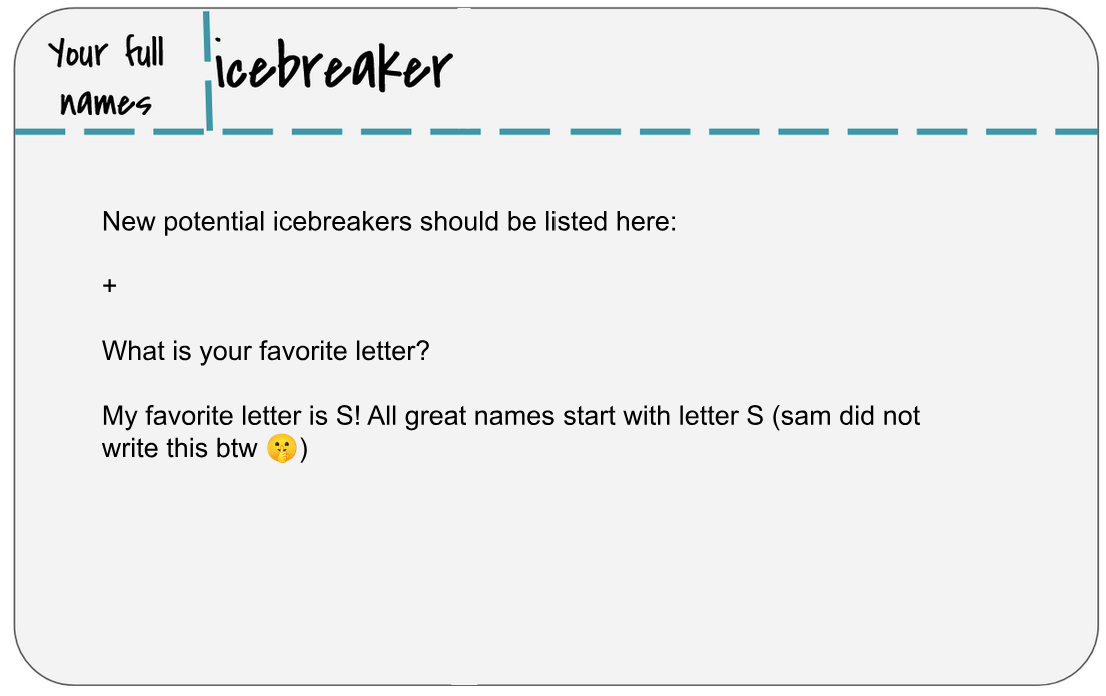
Please make sure that everyone in your group answers the icebreaker and writes their name on the whiteboard. We will come around to collect pictures for attendance soon!
Swap files
If you have ever gone to open your file and encountered the following:
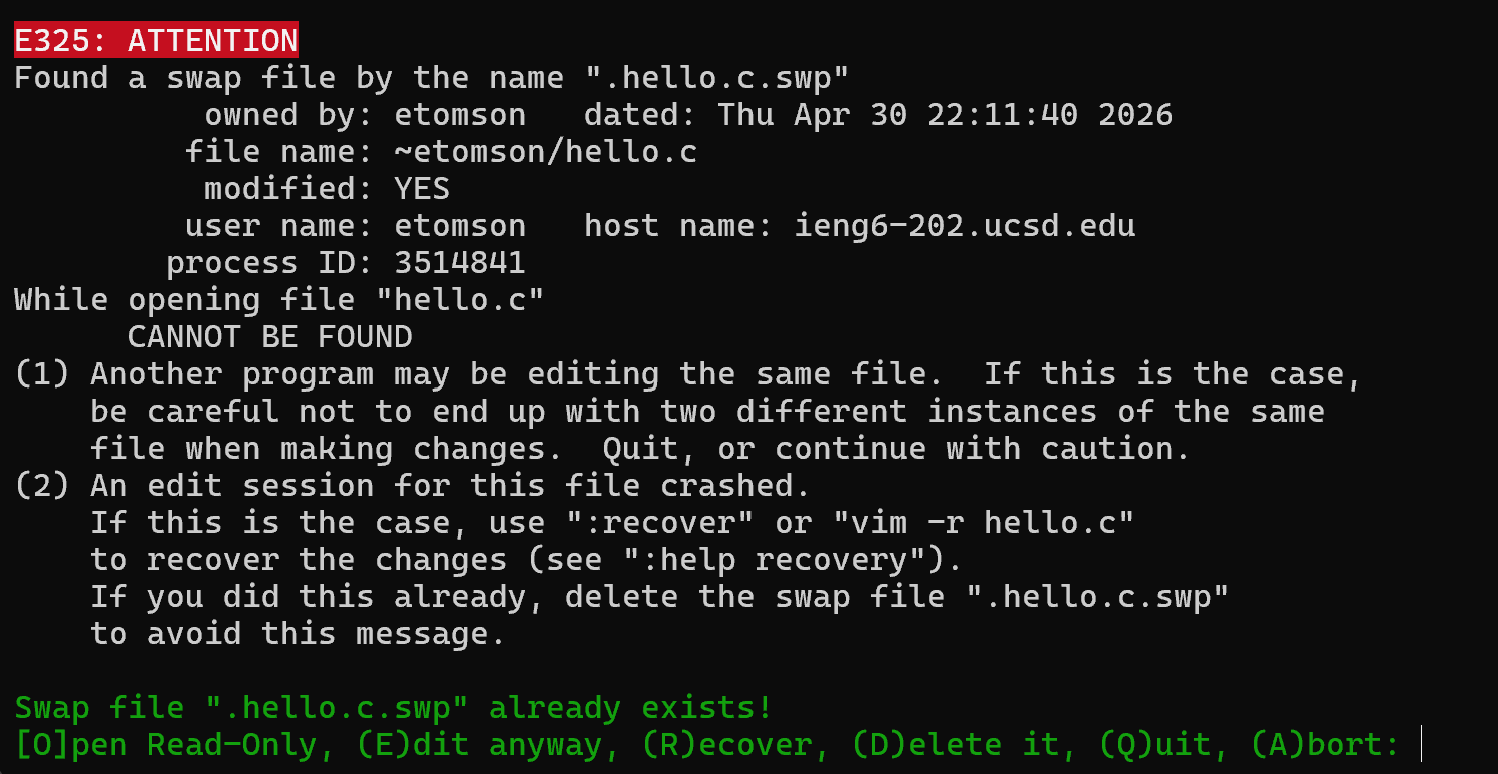
you may have wondered what is going on. This is the menu that appears when you try to open a file but your computer sees that it has an associated swap file. If your terminal crashes for some reason while you are editing it, you computer saves your work in a swap file named as follows: if you had hello.c it will create .hello.c.swp as the swap file (as seen in the picture above). In this file are the changes that it saved for you as it crashed. Reading through the options we find you can:
- Press
Eto open the last save you made. If you are ok with discarding the changes you made after you last:wyou can choose this option. - Press
Rto recover what is saved in the.swpfile. If you haven’t saved recently or simply would like to recover the changes you had made, choose this. After you choose this, you can type:was normal in vim to save these recovered changes to your file.
If you choose the latter option, you will see this menu.
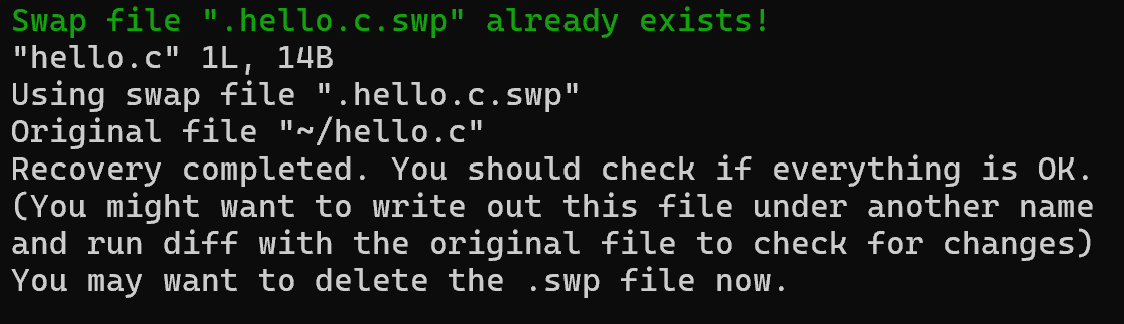
As per it’s suggestion, after you have saved the file and go back to the terminal, you can and should delete the swap file (rm .hello.c.swp for example).
If you choose the former option, you should also make sure to delete the swap file, for fear of later recovering a now out-of-date file.
Some More Vim!
Let’s learn about just a few more Vim commands that might be helpful for the labs and programming assignments.
Moving Up and Down
You may have noticed that moving up and down line by line in a Vim file can be relatively slow. Scrolling up and down the file would be faster!
To scroll down in the file, hold the Ctrl key and press d.
To scroll up in the file, hold the Ctrl key and press u.
Custom Configuration
So far, we have seen that Vim commands can be manually typed in an open Vim window, however this can quickly become repetitive if you commonly want to execute the same commands every time you open a new Vim window.
Alternatively, we can tell Vim to execute a certain set of commands automatically every time we open a Vim window in the future. For example, we can type a command to enable syntax highlighting in Vim, which will add syntax-specific coloring to your code and will vastly improve your experience reading through code in Vim. Another Vim nicety we might want to enable is adding line numbers to the file. There are many, many different commands and settings that we can enable and configure to create our own personal Vim experience, which will make writing code in Vim much more enjoyable!
We will do this by putting these commands directly into a Vim runtime configuration file, called a .vimrc file.
The
.prefix means that it is a hidden file in UNIX, also commonly called a dotfile. This means that these files will not display, by default, when listing the contents of a directory (using thelscommand).
By convention, you will create the .vimrc file in your home directory: ~/.vimrc
Remember: the tilde character
~is a shorthand for the current user’s (your) home directory in UNIX.
Create your .vimrc
Using Vim, create an empty .vimrc file in your home directory on your ieng6 account:
$ vim ~/.vimrc
Then copy the following lines into your empty .vimrc file, as shown in the code snippet below:
syntax on
set number
set belloff=all
set showtabline=2   " always show buffer tabs
set tabstop=4
set noexpandtab   " ensures tabs do not expand to spaces
set autoindent
set smartindent
inoremap { {<CR>}<Esc>ko
set backspace=indent,eol,start
The effect of each of these commands is summarized briefly below:
syntax on: enable syntax highlightingset number: display line numbers in Vimset belloff=all: disable Vim bell soundsset showtabline=2: always show buffer tabsset tabstop=4: set tabs to be four spacesset noexpandtab: does not expand tabs to spaceset autoindent: apply indentation to next line based on current lineset smartindent: apply indentation with respect to code syntaxinoremap { {<CR>}<Esc>ko: autocompletion of curly braces for ease of use
If you find yourself ever working with python, you may want to switch
set noexpandtabtoset expandtab. Python cannot handle having mixed tabs and spaces and will error with the messageTabError: inconsistent use of tabs and spaces in indentation. If you haveset noexpandtabset and edit a python file that uses spaces, this will occur. For our future purposes we need to have real tab characters for when we learn about Makefiles!

In general, you should not paste a command into your
.vimrcif you are not sure what it is doing. But you can definitely trust us! :D
These are our suggestions for .vimrc settings that we think would be helpful for you in this class. If you feel like you don’t like some of these features, feel free to remove the corresponding lines in the .vimrc file. These configuration files are usually customized to each programmer’s preferences—figure out what works well for you!
What the Shell?
The other day, I was working on a class assignment that had me running a bunch of stress test diagnostics for a cloud system. Each test took about a minute to run, and I had to run a bunch of these.
One of my partners asked “why not write a shell script?” And so I did. What would have been twenty-five times of typing the same command with different numbers turned into a single script I could run once and then go about my day. Now, that script probably took more than 25 minutes to write, but that’s beside the point.
Today, you will use shell scripting to organize a messy file system.
Start by cloning our starter repo into your ieng6 account, as usual. Next, change into the minihome directory and take a look at its contents. This directory structure should hopefully look familiar to you!
Before we get started though, let’s talk about shell scripting and the executable bit.
A shell script, as its name suggests, is a script that runs a series of shell commands that accomplishes some tasks. These scripts can get very complicated depending on the task being automated, but even simple shell scripts can save lots of time. In the coming weeks, you may want to write a shell script that runs all the tests in PA 3, for example.
Task 0: Run a script
💡 KEY POINT: Any command that you can run on the command line can be an instruction in a shell script.
- Fill the provided
task_1.shfile with some commands that you know likeecho,ls, orpwd. Each command should be on a new line. - To mark the file as executable, run
chmod +x task_1.sh. - Try running
./task_1.shin your command line, and you should see the output of each command in the order you added them to the shell script.
The #!/bin/bash at the top specifies that this script should be parsed using the bash program at the directory /bin/. The leading #! is called a “shebang” and signals the start of this directive. A Python script, for example, could have #!/usr/bin/python3 as its first line instead.
Here’s an example you can try. Put the following content in task_1.sh:
#!/bin/bash

echo "Hello!"
echo "Goodbye!"
And then, run it. If you see Permission denied and don’t know what to do, go read the executable bit section from lab 2.
$ ./task_1.sh
Hello!
Goodbye!
As it turns out, all that is needed to complete the above task is to run a couple of commands sequentially. Here are a couple of knowledge bits that could be helpful:
The wildcard pattern
*In shell scripting, the
*character acts as a way to target all files and directories. For example, if you rancat *, you would print out the contents of all the files in your current working directory (you would likely also get error messages from trying to view the contents of folders in your directory). Furthermore, the*character can also be used to match specific patterns. For example, if you rancat *.txt, you would print out the contents of all the files in your working directory that have the.txtextension.
The
mvcommandThe move command, as its name suggests, can be used to move files into directories. For example, you can use it like so:
mv a.txt BooksThis will move a.txt into the Books directory. You can also move multiple files at once like so:
mv a.txt b.txt Books, which will move a.txt and b.txt into the Books directory.
Task 1: Books and Music
With these tidbits, you are now ready to write your (possibly) first ever shell script! Your first task will be to write a shell script to organize the text and mp3 files in minihome into the Books and Music directories. Please work on this with your groupmates if you so wish. As a reminder, you can use the ls -R command you all discovered back in lab 1 to test if your files ended up in the right place. While testing your script, you may end up accidentally messing up your directory structure. If this happens, we have provided you with a reset_task_1.sh script in the minihome directory which you can run to reset the .txt and .mp3 files. This will leave your .sh files intact, however, so don’t worry about losing your progress.
Please write what you did for task_1.sh on your whiteboard and check in with your teammates.
Our minihome is now looking a lot cleaner. But maybe we can go further. The length of these books seems a bit varied, no? It would be nice if we were able to sort these books into short stories and novels. This will be your next task. One requirement for your script is that you should be able to supply an argument for the cutoff between a novel and a short story. Before you begin the task, first change into the Books directory.
Here are some knowledge bits that could be useful:
Shell scripting - variables
You can declare and use variables like so in shell scripting:
# Contents of demo.sh
#!/bin/bash
num=5
fruit="apples"
echo $num $fruit
$ ./demo.sh
5 apples
To reference a variable, you simply put a dollar sign in front of it. Note that this still works inside double-quoted strings, so echo "$num $fruit" would have achieved the same effect in the script above. To print out $num $fruit literally, you would need to either use single quotes ('$num $fruit') or escape the dollar signs ("\$num \$fruit").
Shell scripting - accessing command line arguments
To access the nth command line argument, use $n in your script. For example, the 1st command line argument would be accessed with $1. Note that the 0th command line argument is the name of the command you executed. Here is a demonstration:
# Contents of demo.sh
#!/bin/bash
echo $1 $2
$ ./demo.sh 5 apples and more
5 apples
Note that a string wrapped in quotes counts as one argument. For example, in: $ ./demo.sh 2 "PA 2" We have $1 equal to 2 and $2 equal to PA 2.
Shell scripting - if statements
The basic structure of an if statement in shell scripting is as follows:
if [ condition ]; then
    # Commands if condition is true
else
    # Commands if condition is false
fi
Here is an example of a script that takes in a number from the user, and prints out whether or not it is greater than 5:
# Contents of demo.sh
if [ $1 -gt 5 ]; then
    echo "Number is greater than 5"
else
    echo "Number is 5 or less"
fi
$ ./demo.sh 10
Number is greater than 5
As you can see, most operators (save for string equality) in bash scripts are different from what you would see in most other programming languages; they look like a hyphen followed by an mnemonic string. Here, the -gt comparison operator checks if $1 is greater than 5. Though you likely won’t need them for this task, here is a decently comprehensive list of the different types of conditional operators you can find in shell scripting:
File/directory existence:
if [ -f filename ]; then   # Check if file exists
if [ -d directory ]; then  # Check if directory exists
if [ -e filename ]; then   # Check if file or directory exists
if [ -s filename ]; then   # Check if file exists and is not empty
if [ -x filename ]; then   # Check if file is executable
String comparison:
if [ "$str1" = "$str2" ]; then   # Strings are equal
if [ "$str1" != "$str2" ]; then  # Strings are not equal
if [ -z "$str1" ]; then          # String is empty
if [ -n "$str1" ]; then          # String is not empty
Numerical comparison:
if [ "$num1" -eq "$num2" ]; then   # Numbers are equal
if [ "$num1" -ne "$num2" ]; then   # Numbers are not equal
if [ "$num1" -gt "$num2" ]; then   # num1 is greater than num2
if [ "$num1" -lt "$num2" ]; then   # num1 is less than num2
if [ "$num1" -ge "$num2" ]; then   # num1 is greater than or equal to num2
if [ "$num1" -le "$num2" ]; then   # num1 is less than or equal to num2
Shell scripting - for loops
In Bash, there are many different types of loops, each having their use cases. Here, we’ll introduce one of those loops: the for loop. The basic syntax is as follows:
for item in [list of items]; do
  # do something with $item
done
Here are some examples of how you can use a for loop:
-
Looping through variables:
for var in item1 item2 item3; do echo "$var" done -
Looping through a range of numbers:
for i in {1..5}; do echo "Number: $i" done -
Looping through files in a directory:
for file in *.txt; do
  echo "Processing $file"
done
The wc command
Here, wc does not stand for water closet, but rather word count. Passing it a text file will print out the number of lines, words, and characters in that file followed by the name of that file. For example:
$ wc alice.txt
3757  29564 174357 alice.txt
To print out just the number of lines, words, and characters, You can use the -l, -w, and -c options respectively:
$ wc -l alice.txt
3757 alice.txt
$ wc -w alice.txt
29564 alice.txt
$ wc -c alice.txt
174357 alice.txt
If you don’t want the name of the file after, and only wanted the number for whatever reason, you can redirect the contents of the file in to the wc command like so:
$ wc < alice.txt
3757  29564 174357
$ wc -l < alice.txt
3757
Neat!
Shell scripting - command substitution
You can run a command and assign its output (as a string) to a variable using var=$(command). For example:
lines=$(wc -l < sample.txt)
echo $lines
This would store the number of lines in sample.txt into lines and print it.
Task 2: Novels and Short Stories
With the above knowledge, you can now write a script to sort text files into the Novels and Short_Stories folder based on their word length from scratch. In task_2.sh, we have provided you a base script to work off of, with blanks for you to fill. There is also a reset_task_2.sh script, should you wish to restart. To test if your script works, 20000 works well as an argument for differentiating between Novels and Short Stories. Good luck, and have fun!
Once you have made sure that both of your scripts work, we may now proceed to the fun part. First change back to the minihome directory, run the reset_task_3.sh script to undo the changes from both task 1 and task 2. Next, run the task_3.sh script. This is a pre-written script that will run your tasks 1 and 2 in succession. This means that in one command, you can sort all of your files into Books, Novels, Short_Stories, and Music folders!
Confirm that all the text files are in the Novel folder (we used a lower threshold), and all the mp3 files are in the Music folder, and run the reset_task_3.sh script. Make sure your script works before running the next step!
Let’s pretend our user has done a lot of internet browsing and downloaded a lot of files. Run the simulate_downloads.sh script.
That’s a lot of txt and mp3 files! Normally it would take quite a while to sort these out, but luckily, we have our script! Run task_3.sh, and hopefully you should see all of the files get sorted. What normally would have taken perhaps an hour can now be done in an instant!
What should Git ignore?
You may have used the git add . in the past. By default, this means Git should track everything it finds in your repository directory. But you don’t always want to track everything! Here are a few things you shouldn’t track in Git in most cases:
-
Machine code, such as in object files (
.ofiles) and executablesThere are three reasons why you shouldn’t track machine code in Git:
- Git is inefficient at handling large binary files
- Machine code differs from machine to machine, so they are often useless to your collaborators
- Binary file conflicts are cumbersome—there’s no way to integrate conflicts together
As a general rule, you should never use Git to track the outputs of a compilation or transpilation process. In C projects with Makefiles, the targets defined in the Makefile usually represent the outputs of a compilation process.
-
Secret credentials
Many hosted services have public repositories for the source code of the server. The server needs to authenticate itself to get write access to the database, for example. But the keys for such authentication cannot be public or else anyone can tamper with the database!
-
Most hidden files (files whose names start with
., like Vim swapfiles)Do not track your Vim swapfile! Imagine this: You have a terminal prompt and Vim side-by-side. Because Vim is currently running, there is a swapfile in the repository directory. You then commit and push your swapfile to GitHub. Your collaborator pulls it from GitHub without Vim running and tries to edit it with Vim. Because there’s a swapfile, Vim gives them a warning, thinking that another Vim process might be editing the file simultaneously even though they don’t have Vim running. This is counterproductive!
How do we tell Git to ignore them?
.gitignore is the exact name of a special file that Git reads to determine which files to skip when looking for untracked files. If a file’s name matches any line in .gitignore, it is ignored. For example, if a .gitignore file contains:
*.o
Then Git should ignore all files that end with .o. In this context, * is a wildcard that matches any sequence of characters.
It would be nice if we could write an expression that matches all executable files without an extension. As it turns out, we don’t know of a neat way to do this. You could copy the list of targets from your Makefile as an alternative. You could also write a shell script that enumerates all the executable files and writes their names into .gitignore. Beware that the wildcard in Makefiles is %, while the wildcard in .gitignore files is *.
What if they are already being tracked?
You may have committed and pushed these files to Git in the past. To fix this, you can have Git untrack them without removing the actual files themselves by running:
$ git rm --cached path to file to untrack
For example, if you have committed stack.o and want to untrack it without deleting it entirely, you would run git rm --cached stack.o.
Write your own .gitignore
Some of the files in our starter repository should not have been tracked. First, change back from minihome back to the root of your starter repo. Run ls -a to list all the files (including hidden ones), use your best judgment to decide which ones shouldn’t have been tracked, and instruct Git to untrack those files without removing them. Then, write an appropriate .gitignore file. To check your work, run git status. The files you untracked should not appear in the list of “untracked files”, and when you run git add ., they should not become tracked again. Don’t hesitate to work with your group and ask for help!
- Even though
.gitignoreis technically a hidden file, you should track.gitignoreitself. This prevents your collaborators from tracking the files you don’t want to track.- You might have noticed the
.gitdirectory. This is Git’s hidden workspace, where it stores your repository’s commit history and branches. Git will never track.gitby default, as this would end up requiring infinite space. Therefore, you don’t need to put it in.gitignore.
Please write what you added to your .gitignore on your whiteboard.
You’ve got Mail!
The mail command, unlike other commands we’ve taught you in this lab and previous ones, is especially unique: literally no one* uses this! As such, this section is not relevant to any course material. But the idea of sending each other mail via the terminal, all 1970s-core, is too appealing to pass up on.
* By “literally no one”, I mean “literally no one, except for at least one person at this university”, so I’ve been told.
Throughout this section, we’ll use myname and friendname to refer to your and your partner’s UCSD username, respectively. This is the username you use for your UCSD email, and the one you use to log into ieng6.
In order for mail to work, you and whoever you are mailing to must be on the same cluster on ieng6. You do not need to know what a cluster is, but you do need to know how to SSH into a specific one on ieng6. If each line of your command prompt starts with this:
[myname@ieng6-640]:~:500$
Then ieng6-640 is the cluster you are logged into. In order to SSH into a specific cluster, exit out of your current SSH session, and in your local machine terminal, type:
$ ssh myname@ieng6-640.ucsd.edu
And enter your password as usual. Make sure both you and your partner are on cluster 640.
In the following instructions, you will use the mail command, but it is not available on the ieng6-2xx servers. Please make sure to log out of ieng6 and then sign into ieng6-640.ucsd.edu! This specific cluster runs an older operating system that still has the mail command.
Once you and your partner are in the same cluster, try using the mail command to begin composing an e-mail (electronic mail). Either command below works:
$ mail friendname@ieng6-640.ucsd.edu
$ mail friendname@ieng6-640
This will prompt you with Subject: so you can type your email’s subject. The subject is only one line of test, so when you press Enter you are now typing the contents of your mail. When done writing your message, press Ctrl+D to finish and send.
Now, your partner can use the mail command by itself to see that they have received mail! It will have a number next to it as it enumerates messages every time you open the mail shell. Type this number and press Enter to see the message.
Now that you have mail and therefore can enter the mail shell, you can type ? to get a list of commands that you can use.
type <message list>          type messages
next                         goto and type next message
from <message list>          give head lines of messages
headers                      print out active message headers
delete <message list>        delete messages
undelete <message list>      undelete messages
save <message list> folder   append messages to folder and mark as saved
copy <message list> folder   append messages to folder without marking them
write <message list> file    append message texts to file, save attachments
preserve <message list>      keep incoming messages in mailbox even if saved
Reply <message list>         reply to message senders
reply <message list>         reply to message senders and all recipients
mail addresses               mail to specific recipients
file folder                  change to another folder
quit                         quit and apply changes to folder
xit                          quit and discard changes made to folder
!                            shell escape
cd <directory>               chdir to directory or home if none given
list                         list names of all available commands

A <message list> consists of integers, ranges of same, or other criteria
separated by spaces.  If omitted, Mail uses the last message typed.
Note that when the help dialog says “folder”, this is a bit of a misnomer. The “folder” is actually the filename that the command will use. For the save and copy commands, you can give it a valid path to a file and it will save or copy the contents of the email into the file. The path is relative to wherever you opened the mail shell.
You will likely not need to use all of these commands but at least a few are worth noting:
type <message list>can be used to print out the contents of selected messages. For example,type 3 4prints out the contents of messages 3 and 4.headerswill print out the list of enumerated messages along with their senders, subjects, and statuses.- You can respond to a message with
Reply <message list>, which will open a response to the message to type in a reply. Again, you can finish and send withCtrl+D. For example,Reply 5opens a response to message 5.
There also exists another method to send mail from outside the mail shell, using the pipe operator we learned earlier. This command also makes use of the echo command, which outputs its argument to stdout. Sounds redundant, but it’s intended to be used in this way to input strings into other commands, or to be used as print statements in bash scripts.
$ echo "email body here" | mail -s "subject here" friendname@ieng6-640.ucsd.edu
Trading Pokemon
We can also use email to send attachments in the form of files. In this section, we’ll trade Pokemon with each other via mail. We will use the pokeget.sh script provided in your lab starter code for fun to generate some files with Pokemon in them. First, let one person be the sender, and the other will be the receiver. After you can successfully send and receive Pokemon from one to the other, swap roles and try sending one the other way.
Sender
Use the below command to generate a “.pk” file with the name of the Pokemon you picked. For example, if you picked Pikachu, #25, you would call this file pikachu.pk. Alternatively, if you want the receiver to not know what the Pokemon is until they open the file, you can call it mystery.pk. Feel free to replace 25 with the National Dex number of any Pokemon.
./pokeget.sh 25 > pikachu.pk
If the pokeget.sh script seems to take more than a few seconds to finish running, try using Ctrl + C to interrupt the program and try running the same command again.
Once you have a “.pk” file, use the following command to send it to your partner, using the -a option. Replace “pikachu.pk” with the name of your Pokemon file if it is different.
$ echo "email body here" | mail -s "subject here" -a pikachu.pk friendname@ieng6-640.ucsd.edu
Receiver
Open up your mail shell with the mail command. You should have a new email if the sender did their job properly. Type the following command to save the email you received as a file, with n replaced by the ID number of the email. Note that the “&” is the prompt, and does not need to be typed, just like “$” in the terminal.
& save n pokemon.mail
Extracting the attachment in a readable form from the email itself is quite involved, so please use the provided script to get your Pokemon:
./extract_pokemon.sh pokemon.mail > pokemon.pk
cat pokemon.pk
If you get an error running
extract_pokemon.shthat mentions something about a bad interpreter, this is likely because the file hasn’t been formatted for unix correctly yet. Runsed -i 's/\r$//' extract_pokemon.shto reformat the file and try again.
If everything went well, you should get the Pokemon your partner sent you! Have a bit of fun with this and send each other some cool Pokemon.
Please spend a couple minutes drawing the pokemon you received from your neighbor. You can take turns drawing and reading through the next part.
HACKING
This is the same file you may or may not have started in lab 3 and can be found in this github classroom in the gradebook directory.
Background
Imagine that you’re a less ethical student than I’m sure you actually are. You overhear from some other students in lab that there’s a binary available on the pi-cluster that can show you your grades on assignments before we formally release them. You hear quieter whispers that someone found a way to use it to change their grade. Given our less-than-ethical assumption about your state of mind, you might be tempted to exploit this for yourself.
The Plot Thickens
You see some code open on the professor’s laptop during office hours. You do your best to commit it to memory and write it down (remember, you’re acting quite unethically in this story), because it strikes you that the code was something regarding assignment scores.
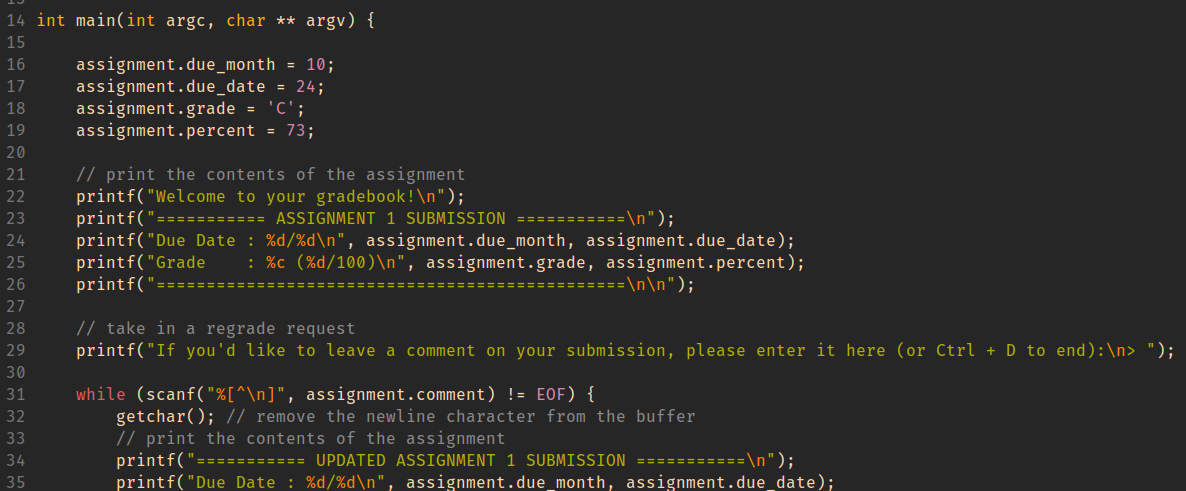
Using this information, you decide to give yourself and A with a score to match while maintaining a real due date.
HINT When important values are adjacent on the stack, overflowing an array with values that you control can let you assign into other stack-allocated values.
GDB commands that may be useful for this activity:
-
(gdb) info locals -
(gdb) info args -
(gdb) print VALUE (or p VALUE)You can print any variable or expression, e.g. -
print x,p arr[5],p ((x & 0b1111) << 3) -
You can also specify a format to print in
-
print/t(binary),print/x(hex),print/d(decimal) -
(gdb) x ADDRESSThis prints out memory at an address, e.g. strings / arrays / pointers -
(gdb) x/16cb str1This prints the first 16 bytes ofstr1as characters -
(gdb) x/20xb str2This prints 20 bytes ofstr2in hex -
(gdb) x/4dw arrThis prints 4 “words” (i.e.int32s) ofarr, as decimal numbers -
You can use the following reference card for reference on gdb commands, and format commands for x and print.
The Finale
There are now 2 fun optional activities you can complete:
- Mass mailing, where you send your pokemon to a mailing list of recipients who would be delighted to have your pokemon
- Pokemon
.bash_profile, how to add pokemon to print whenever you open your terminal.
You can do either or neither in any order, they are here for your own practice and amusement.
Mass mailing
Optional
Another useful function in scripting is the while loop. For example, running:
while read character; do
    echo "$character is a transformer"
done <transformers.txt
Given that transformers.txt contains:
Optimus Prime
Bumblebee
Grimlock
Kickback
Hardshell
Starscream
Megatron
Metroplex
Ironhide
Will print:
Optimus Prime is a transformer
Bumblebee is a transformer
Grimlock is a transformer
Kickback is a transformer
Hardshell is a transformer
Starscream is a transformer
Megatron is a transformer
Metroplex is a transformer
Ironhide is a transformer
Given this and the command to send mail:
$ echo "email body here" | mail -s "subject here" -a filename friendname@ieng6-640.ucsd.edu
Where -a filename will attach the file with filename to the email, send everyone in recipients.txt your Pokemon. Please send this to the list in recipients.txt no more than once. To test your loop, you may want to make a file of your groupmates’ emails in the same format of recipients.txt. Note that you may also send mail to yourself.
Adding Pokemon to .bash_profile
Optional
If you would like your Pokemon to appear when you open ieng6, you may do the following.
If you would like 1 Pokemon, add the line cat ~/path/to/pokemon.pk (replace the path with the entire path to your Pokemon file, starting with ~) to the end of the .bash_profile file in your home directory.
If you would like 2 Pokemon, add the line paste ~/path/to/pokemon/bigPoke.pk ~/path/to/pokemon/smallPoke.pk (replace the path with the actual path to your Pokemon file) to the end of the .bash_profile file in your home directory. Note that if you paste the smaller Pokemon first, the larger one will be cut in half. You are welcome to try to troubleshoot this.
If you want to do the same thing on your own computer, you can add this same line to your .bash_profile or .bashrc file. Just make sure to download the referenced .pk files using pokeget.sh and edit the paths as needed!
Other Real world Script examples:
A real life script by Katherine Izhikevich and Ben Du which run several python scripts to retrieve and sort through data.
The script Elena made to print out pokemon randomly when she opens ieng6 pokemon.sh (complete with commented out old path variables before she figured out how to pick randomly from an arbitrary amount of directories.)
The script Elena made to print out Joe quotes also upon opening ieng6. juotes.sh Note that the file is full of lines that look like
Feb 10 -|Energy is priceless, but so is uninterrupted descriptions of structs.
Sept25 2025 @10:16? -|I'm thankful to the computer engineering wizards that provided the magic sand to do this
The script Brendan made to automatically zip and re-install python addons for the 3D software Blender. blender_addon_updater.sh
Note: Understanding scripts.
Bash scripting is no small undertaking to understand. It’s basically a whole new programming language with it’s own syntax and rules, and while this lab covers a ton of the basics, there is a whole truckload of other things. While you do not know everything there is to know about bash-scripting, you do have a foundation of knowledge and internet access. Both google searching and asking ChatGPT can be super helpful for 2 things: understanding a script, and making one.
Wonder what mapfile is? googling this gets an AI overview describing it and a link to a man page. This may lead you to the thought “oh right the man pages, maybe I should check it on my computer”.
pokemon.sh was made with much help from ChatGPT. Elena had a starting point but was unfamiliar with how to get prefixes, suffixes, or how exactly to randomly pick between folders. So, she used ChatGPT how she might switch the file extension from .mail to .pk. Prompts included “how would I remove a prefix” and “how do i pick randomly from a list” to piece together the script.
It is also noteworthy that GenAI models will be good at things they have a lot of training on. Common things like what we find in pokemon.sh they will get correct a lot. Things they are not as well trained on they may very well get wrong and they will do it confidently. So, please do be careful.